
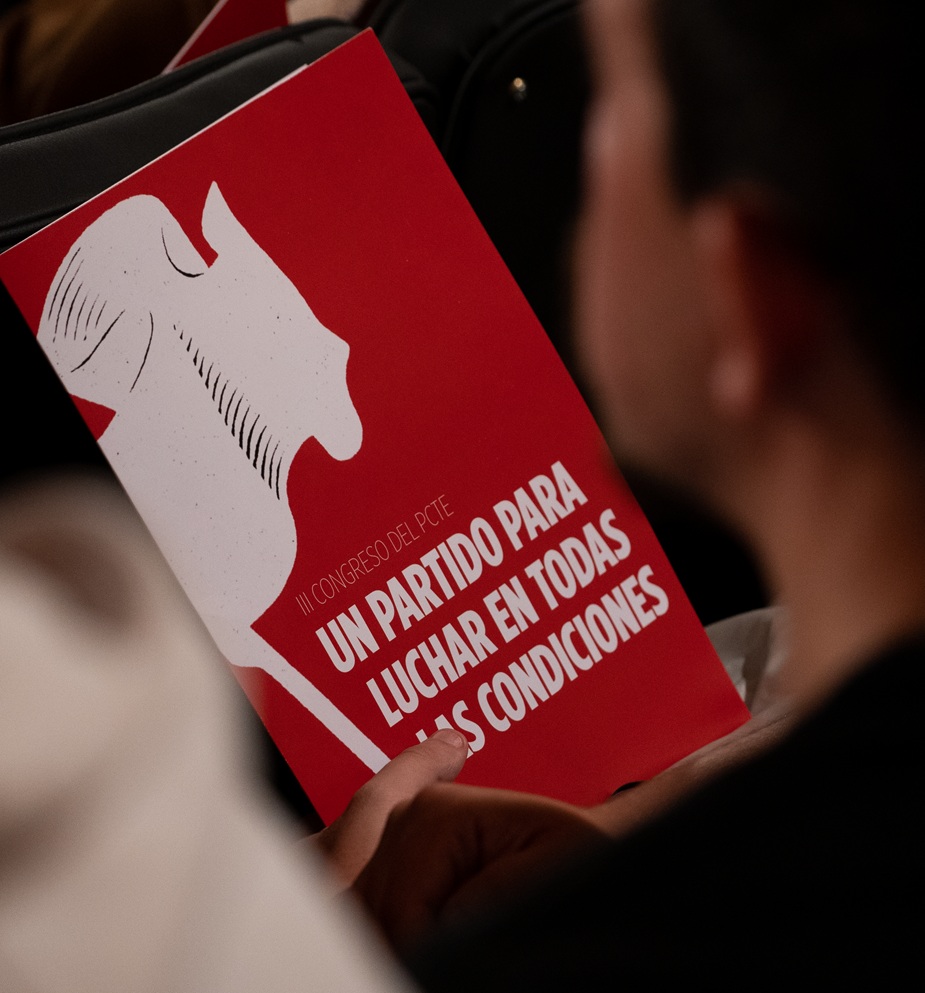
The situation of the working class and class struggle, in both the national and international contexts, are collectively assessed in the plenary sessions of the Central Committee of the PCTE. From such assessment, the Party defines its political priorities and guides its tasks according to the documents adopted in its Congresses.
The following text reflects some excerpts from the Political Report adopted by the Central Committee in its last plenary session. Some of the main thoughts about the current situation and the challenges the working class is facing are synthesized in them. This draws the framework within which the PCTE carries out its intervention and its political proposal.
Excerpts From the Political Report Adopted by the 2nd Plenary Session of the Central Committee of the PCTE
January 31st, 2026
…
International Situation
As it is well-known, the priority of the Congress discussions was to assess the weaknesses and limits in the model of party development in order to take the suitable measures enabling us to realize the slogan of “struggling under all the conditions”.
From the end of the 3rd Congress to the holding of this 2nd Plenary Session, the success in focusing the Congress in this way became evident for everybody. The drop of the mask used by US imperialism, with its interventions in Venezuela, the threat to intervene Iran, and the situation created regarding Greenland, are examples of how the conditions under which we struggle can change overnight — something we should be suitably prepared for.
We are talking about the drop of the mask by the US imperialism because what is happening in this Donald Trump’s second term is just the harsh expression of what has been the international US policy in this century and the previous one. The economic and political interests that were before concealed by the appeal to the defense of democracy and human right are now openly and mercilessly expressed. This eases, to a certain extent, our intervention, since it is easier for us to place the real keys to the relations between powers and blocs.
After the first year of Donald Trump’s second term in the USA, the trends we expressed in Thesis I in our Congress —regarding the weakening of the USA-EU alliance or the growing sharpening of contradictions between the various powers and blocs— have been clearly manifested.
The months after the Congress have offered to us numerous examples of such reality. We can start by the issue of the US National Security Strategy (NSS25) in late November, Maduro’s kidnapping in Venezuela in early January, or the escalation in the tension regarding Greenland. This is to be added to the evolution of events in the war of Ukraine, the more recent events in Iran, or the development of the so-called “peace process” in Palestine, with which the USA intends to replace some of the functions being carried out until now by the UN.
We are focusing this part of the report on the US actions and stances because these are the ones creating relevant changes within the framework of inter-imperialist relations — not regarding their nature, but mainly regarding their style. But, especially, because the US actions and maneuvers in the last months have turned into the epitaph of the scheme of international relations that emerged after World War II.
This basically means that the interested usage of international law is no longer required in the relations between powers and countries, and such relations are openly realized according to one’s strength. The case of Nicolás Maduro’s and Cilia Flores’s kidnapping is paradigmatic: a military operation to capture and move the head of another state to the attacking power, under invented accusations, in order to proceed to his “trial” before the courts of such power, at the same time that it is openly expressed that the main US interests in the area are Venezuelan oil and resources as well as the political dominance of the Caribbean.
After Maduro’s kidnapping, several threats to the leaders of Latin American countries —and quite particularly Cuba, which still is the main pain in the neck for the USA in the are and the target of further provocations, aggressions, and interferences in the near future— have been made. With all of this, it seems that the full functionality of “Trump corollary” to the Monroe Doctrine is confirmed, as announced in the NSS25 and expressed in the following terms:
“After years of neglect, the United States will reassert and enforce the Monroe Doctrine to restore American preeminence in the Western Hemisphere, and to protect our homeland and our access to key geographies throughout the region. We will deny non-Hemispheric competitors the ability to position forces or other threatening capabilities, or to own or control strategically vital assets, in our Hemisphere. This “Trump Corollary” to the Monroe Doctrine is a common-sense and potent restoration of American power and priorities, consistent with American security interests.”
It should be taken into consideration that —in geopolitical terms— the reference to the “Western Hemisphere” is essentially to the American continent, its neighboring islands, and the territories in Polar areas. This explains, among other factors, Trump’s insistence in Greenland, which would totally be part of such “Hemisphere” in which they intend to “restore” their preeminence. Once what has been made in Venezuela has been tested, any sort of means to carry out such “restoration” is possible.
Apart from the international matters, the apparent situation of internal instability should be also noted. This is caused by the policies carried out against migrant population —which have taken place mainly in areas ruled by the Democratic Party— and the “anti-Left” and almost civil-war-ish rhetoric used by high representatives of the Trump administration. It is evident that part of the rhetoric employed outwards is also employed inwards, and that there is a social contest we should better know. However, the evolution of events does not allow to discard new episodes of a serious internal crisis, similar to those after the results of the previous Presidential Election, according to the results of the mid-term elections that will be held this years — which do not seem to be favorable for Republicans.
Two questions should be made in this moment. One of them is to what extent does such official recovery of the Monroe Doctrine mean a lesser US interventionism in other geographical areas in the world. The other one is what role are the European powers and their alliances going to play, once the US leaders have openly expressed that the model of “trans-Atlantic relation” is dying.
As of the first question, our answer is “absolutely none”. Contrary to what is being spread, the new US National Security Strategy does not mean a decrease in the US role throughout the world, but a reformulation of its ways, methods, and justifications. The fact that Biden’s NSS was focused on the struggle between “democracy and autocracies” and Trump’s emphasizes the “USA first” and the recovery of specific spheres of influence does not exclude that both doctrines are tied to the US interests in the situation of other parts of the world or, better said, that the US interests go far beyond their borders and their region.
Trump Administration’s goal is to remain ahead of China as the world power, based on the superprofits of certain technological monopolies —completely aligned to the Government—, which are invested again to a great extent in the development of the US military capacity.
Regardless of nuances, formulas, or arguments, US interventionism is not going to disappear. First, in the “Western Hemisphere”, later in the “Indo-Pacific” area, and finally in Europe and the Middle East. All of this is framed within the boost of US technology and a change of style from the so-called “soft power” to “hard power”, which also pursues a particular effect in the masses from different countries.
In terms of inter-imperialist competition, there is no difference in placing that contradictions are a result of the clash between political models or the strangulation of national economic interests. The ideological mantle inter-imperialist contradictions are intended to be concealed under cannot divert us from the fact that such contradictions have not only not disappeared nor decreased, but furthermore they are being created under increasingly more violent terms. The hypothetical recovery of a clearer demarcation of spheres of influence for the three main world powers (USA, China, and Russia) does not exclude in any way the clashes between powers and blocs, and neither guarantees a more peaceful world. It actually introduces greater levels of complexity for the workers’ struggle in each country and the practical structuring of internationalism.
…
Maduro’s kidnapping, and also the events that are taking place in Iran and the threat of a foreign military invasion in that country have reopened in some spaces the discussion on which is the consistent internationalist stance. The terms under which such discussion is taking place are in essence the result of years of permeation in the communist movement of the theses on multipolarity, which are essentially a reflection of the abandonment of the class-oriented perspective and its replacement by the geostrategic perspective. This also reflects the relative weakness of the workers’ movement against the bourgeoisie, which eases that almost all the social and historical phenomena are being approached in terms of subordination to bourgeois interests.
Between the fantasies of those who legitimize any government for its mere “opposition” to the United States and those who ignore the ability to immediately co-opt the workers’ and popular dissatisfaction —and even its promotion— by other powers, there is a space for consistent internationalism capable of taking into consideration all the variables present at every conflict and carrying out a mass-oriented policy, in each country, that can put the domestic bourgeois legitimacy into question as well as bourgeois legitimacy all over the world.
Among other things, this entails knowing terms under which the different movements against governments —considered as “enemies” by one or another power— have been created and have evolved; the use of social unrest generated by economic, religious, ethnic, or language reasons —many times as a result of the maneuvers or previous actions of the main powers—; and third the ability to generate any kind of sympathy and legitimacy for any action carried out with the purpose to solve this sort of situations.
For us, an essential starting point if that foreign interference —no matter how inevitable can it be in this historic moment— is an additional difficulty for the advance of revolution in any country. IN a world where the socialist bloc no longer exists, every foreign interference in a country is always conducted to promote the change or the maintenance of the bourgeois faction in power — including with it the preservation or modification of the particular form the bourgeois dictatorship is exercised.
In our era, it is impossible to find a phenomenon for a strong social mobilization or changes in a country in which, first, the working class is not subordinated to other social sections, regardless the fact that some of the demands or the elements for the gathering of mobilizations have workers’ and/or popular components, such as living standards or social deprivation.
…
On the other side, a primary practical problem is to base one’s assessments on the defense of one capitalist power or another, with no proposal of workers’ power for both the aggressors and the aggressed. Third, the main responsibility of each Communist Party is to clash with its own bourgeoisie, its State, and the capitalist alliances of which it is a part.
The legitimately internationalist stance is in each moment drawn from the combination of these three factors. This is a two-way stance, because it has an “inwards” component as well as an “outwards” one. In our case, the first essential issue is the frontal rejection of every foreign aggression or interference in the evolution of events in each country. Inwards, this is particularized by the emergence of the greatest opposition possible to the participation of our country in the imperialist alliances that conduct or legitimize such interventions — an issue that cannot be separated from the emergence of the greatest opposition possible to the bourgeois power in Spain as a whole. Outwards, this particularization is carried out by the favoring, support, and highest solidarity with the forces struggling —like we are doing here— to raise the greatest opposition possible to the bourgeois power and its international alliances in their respective countries, naturally including both those from both the aggressor and the aggressed countries. Such support, solidarity, and favoring are headed to the goal of making each Communist Party to find itself under the best conditions to take advantage of the unleash of any revolutionary situation that might be caused or, at least, to be under better conditions for the struggle in the next term, according to the evolution of events.
The problem of assessing in broad strokes the phenomena of foreign aggression and interference is that, first, it leads to neglecting the different possibilities opened to the revolutionary forces — if they are prepared or under basic conditions to take advantage of the new scenarios in the involved countries. An example of this: the US intervention in Venezuela and the terms under which it is being carried out brings to the table the existence of various factions in the PSUV Governments, and even their role as counter-revolutionaries and functional allies of US imperialism, and this opens the way for Venezuelan communists to carry out a particular work related to the limits of capitalist powers under the specific expression of the “Bolivarian model”.
…
Likewise, the events in Iran or any other country enduring pressure, sanctions, or threats of intervention cannot be approached with binary schemes that force anyone to choose between the uncritical support to a “besieged” bourgeois government and the implicit justification of the imperialist interference. Both paths lead to the political disorientation of the working class and the practical renouncement to the construction of a revolutionary alternative of its own. Our task precisely consists in breaking with this false dilemma, simultaneously pointing to the reactionary nature of every imperialist aggression and the structural limits —if not the openly counter-revolutionary nature— of the national bourgeoisie ruling those countries.
From here, it follows that consistent internationalism is neither a comfortable nor immediate stance, but a political guidance that demands the particular assessment of the particular situation, the patient intervention among masses, and a clear demarcation from all the bourgeois factions. This is not a question of denying the reality of external aggression or minimizing its devastating effects on the living standards of the masses, but of preventing that such aggression could be used to censor any class-oriented criticism and subordinate the workers’ movement to the projects for capitalist management presented as the “lesser evil” or as an alleged barrier against the ruling imperialist powers.
For all these reasons, the deepening of the crisis of capitalism and the worsening of inter-imperialist contradictions present before us an unavoidable historic responsibility. We either fully assume the need to reinforce the ideological, political, and organizational work under the key of class independence or be dragged into alien dynamics that will turn the communist movement into an auxiliary force for any faction of capital. The preparation for scenarios of greater clash —including the possibility noted in the Theses of a generalized imperialist war— cannot be detached from the preparation for scenarios of revolutionary outbreaks, no matter if they could be partial or unequal.
With this analysis in our hands, our intervention against an imperialist aggression entails the use of such situation to reinforce class independence, weaken our own bourgeoisie, and prepare the communist forces for scenarios of greater clashes, without falling into the geopolitical alignment nor abstract pacifism. The key is not to “take sides between States”, but to intervene in order to turn the working class into a political subject prepared for more serious conditions. Particularly, this can be carried out if we base our intervention and stances on four pillars:
- Against the imperialist aggression, clearly pointing out to the aggressor and mobilizing masses against war and its material consequences, not granting any political legitimacy to the aggressed bourgeois State, even though the existence of economic sanctions affecting the lives of the population in the aggressed country is to be criticized too.
- Centrality of the struggle against our own bourgeoisie, which is directly an aggressor or an accomplice of aggression, raising the severance with the imperialist alliances in which Spain participates, the break in the military agreements with aggresor powers, the closure of foreign bases, and the return to Spain of troops deployed abroad.
- Internationalist class solidarity, primarily expressed towards the working class and the peoples —and not towards governments— and particularized in the support to communists and/or the revolutionary workers’ forces in the aggressed country and the promotion of the greatest international coordination possible against war and capital; the goal of all of this is to favor the conditions under which the revolutionary forces can intervene stronger in each involved country.
- Prospect of the workers’ power, attaching the particular situation of the aggression to a political exit of its own, preventing that the possible mobilizations could be trapped into sterile pacifism or the support to bourgeois forces within each country.
The second question we raised before, related to the European powers and their alliances, forces us to assess another phenomenon that will clearly influence our future political work. It cannot be denied that we are in a moment of weakness for the European Union and NATO itself as an alliance between the European powers and the USA. The official EU stance —which refuses to consider the US intervention in Venezuela as a violation of international law— and the relation between both theoretically allies regarding Greenland are clear evidences that such reality, which answers to the narrow bonds some EU countries have with our powers. This does not allow a suitable integration in capitalist terms.
The commercial subject of the situation of the EU has been eye-catching. On one hand, the temporary stoppage of the agreement with Mercosur, after 25 years of negotiations, has been “compensated” by the free trade agreement with India — which has taken its time but has been accelerated in the last two years. Apart from becoming an example of how trade alliances are shaped and reformulated according to the changing context, such agreement also proves that the so-called BRICS are not a homogeneous bloc and every power pursues its own interests.
Because of the EU situation of relative weakness, some voices that suggest a new orientation of international alliances for European powers towards the East —since the relations towards the West are increasingly more conflictive and problematic— are arising. Other voices, among which all the Spanish social democracy are to be included, are promoting the idea of the EU strategic autonomy without breaking with the general framework. They are actually two sides of the same coin, since such suggested strategic autonomy cannot be understood without the possibility of negotiations or possible alliances with other blocs or powers, different from the USA — whether it is China, Russia, or other areas such as Mercosur.
The fact that the EU is an alliance called into question —mainly by the most reactionary positions of the bourgeois forces— does not change our strategic proposal for this alliance, in the same way that the hypothetical US exit from NATO does not entail any substantial change in our stance about the Atlantic Alliance. None of both inter-State alliances changes their nature for having —or not having— the support or presence of the first imperialist power. However, we cannot deny that some new elements, which should force us to refine our political work, are being introduced into the equation.
Our responsibility, as previously expressed in this document, involves the development of a political guideline not limited to denouncing the historic subordination of the EU to the interests of US imperialism, but capable of unmasking the very imperialist nature of the European Union and the bourgeoisies comprising it, regardless of the particular orientation adopted by their international alliances in each situation. The relative weakness of the EU does not turn it into a progressive actor not opens by itself a scenario favorable to the working class. On the contrary, it increases the tensions between the European bourgeosies and sharpens the offensive against the social, labor, and democratic rights of masses.
In this context, the discourses on the “European strategic autonomy” are playing a specific ideological role — presenting what is nothing but an attempt of the European bourgeoisies to reinforce their capability for the inter-imperialist competition and the military, economic, and political intervention in third countries as a common project of the peoples. The construction of an European defense, the reinforcement of their own military industry, or the redefinition of commercial and geopolitical alliances do not pursue the ensuring of peace or people’s sovereignty, but the ensuring of better conditions for the European accumulation of capital in an increasingly more unstable global scenario.
For the working class and the Communist Parties, this entails the utter rejection of any attempt of uncritical alignment with the projects of “reforming” or “refounding” the EU by using social democratic or bourgeois sovereignist parameters. There is no “social”, “peaceful” or “autonomous” EU at the service of the peoples within the margins of capitalism. Any strategy that does not come from the break with the EU and NATO —as the particular expressions of the power of capital— is doomed to the reproduction of the political and ideological subordination of the workers’ movement to the interests of its own bourgeoisie.
At the same time, the weakening and the internal contradictions of the EU generate new scenarios, from which the revolutionary forces can take advantage if there is enough political and organizational preparation. The fragmentation of interests between the European powers, the call into question of the mechanisms of internal cohesion, and the increase in social dissatisfaction against the policies of austerity and militarization can create deep political crises in different powers. Our task is to intervene in such crises with the clear proposal of the workers’ power, connecting the struggle against the EU and NATO to the struggle against capitalism in each State.
In the case of Spain, this is particularized in the direct clash with the Spanish bourgeoisie, its active participation in the European and Atlantic imperialist projects, and all the political forces that work for the strengthening of the integration in such structures under any disguise. The exit from the EU and NATO is neither an abstract slogan nor a goal by itself. It is a necessary moment in a broader process of revolutionary break that can only finish in the implementation of the power of the working class.
In conclusion, we must state once again that the crisis in the EU should not foster illusions nor strategic disorientation. Far from supporting geopolitical rebalancing or new imperialist architectures, our work should be focused on strengthening the political independence of the working class, on raising their conscience and organization, and on preparing the conditions to turn the inevitable crises of the European bloc into opportunities for the advancement to a revolutionary transformation of society. Only from this prospect, it is possible to give a true content to proletarian internationalism in the current European scenario.
Situation in Spain
In Spain, the political government regarding the government and the parliament is currently characterized by three elements we should assess:
- the worsening of the socioeconomic situation endured by the working-class majority, which is not correlated to the positive macroeconomic data, which depend to a great extent on the European funds that will be terminated on August 31st, 2026;
- the increasing manifestations of parliamentary weakness by the government of coalition, expressed by the constant use of Royal Decrees and the failure in the implementation of the new funding model for the autonomous communities;
- the reopening of the electoral cycle since the autonomous elections in Extremadura, followed by Aragón, Castile and León, and Andalusia; excepting the latter, they all have PP minority governments.
The core element of the situation is the sustained worsening of living standards for the working class, as opposed to the official discourse that insists in the macroeconomic recovery. Such contradiction is not accidental, but rather intrinsic to the functioning of Spanish capitalism in its current stage.
The recent economic growth lays on the low added value and the high labor exploitation, the massive transfer of European funds oriented to sustaining the accumulation of capital, and a housing and financial model that extracts incomes from salaried work.
The 2025 macroeconomic data of the Spanish economy —at least the part that is already known— present a positive trend, which contrasts with the evolution of these same indicators in other countries and the Eurozone and the EU as a whole. Nevertheless, such macroeconomic figures are not correlated to the living standards and labor conditions of most of the population.
In a sphere particularly related to labor, the increase in population affiliated to Social Security and the decrease in the official figures of unemployment contrast with the information that casts a worrisome situation: the increase in the formalization of permanent seasonal contracts as well as the dismissals caused by not passing the trial period. Both issues are closely related to the last labor reform adopted by the government of coalition and supported by the main trade unions.
The dichotomy between the figures of employment and affiliation on one hand and the reality of the conditions under which labor power is sold is one of the facts that prevent the Government to use the macroeconomic data to counterweight other sort of discussions and issues, which are now more decisive in the Spanish parliamentary political scenario. If the positive evolution —in capitalist terms— of the Spanish economy is not perceived by huge sections of people, such figures are not useful for the political discussion between the bourgeois forces.
This positive development —we insist, in terms of macroeconomic data— is closely related to the impact of European funds, as we noted in our Congress Theses. The final date for their execution is this year, on August 31st. Therefore, we are in a key year for finally verifying what has been the level and sense of the use of such funds, and their real impact in the updating and modernization of Spanish capitalism.
The European funds have worked as a temporary mechanism of stabilization for the system, not as a lever for structural transformation — its goal according to propaganda. If the capitalist Spanish economy is —as we have being stating— deeply “doped” with the effect of such funds, and public resources are being temporarily freed for the maintenance of part of the “social shield” presumed by the social democratic coalition, the opening of a subsequent period of adjustments and new aggressions against the workers’ and people’s rights is foreseeable. Such rights are generally being strongly questioned by the organizations that aim at replacing PSOE-Sumar at La Moncloa.
The significant increase in the cost of the shopping basket (a 35% rise in three years, according to the Spanish Organization of Consumers and Users), housing (12.1% interannual increase in the third quarter, according to the National Institute of Statistics, the square meter is more expensive than ever in history), or the situation of a “great review” in the renting contracts signed in 2020 are not counterweighted by salary increases in both the public and private sectors — thus unable to prevent a decrease in purchasing power for huge sections of the population.
The social unrest created by this situation is tangible, but the solutions put forward by the capitalist parties are not capable of dealing with it, as they cannot overcome the contradiction caused by the most basic social needs being covered with increasingly more profit-making commodities, in which there is a growing interests for the investment of capital.
…
The second big theme of the political moment is the parliamentary weakness of the Government of coalition, which has become a structural feature of the term. Such fragility comes from both the narrow numbers of the majority and the ideological and territorial heterogeneity of parliamentary supports. This forces the Executive to a constant and highly unstable negotiation.
One of the most conspicuous manifestations of this situation is the frequent use of Royal-Decree laws as a law mechanism. Its systematic use evidences the difficulties of the Government to carry initiatives forward via ordinary law, which creates a situation of disorientation caused by the fact that the contents of such rules —as they require to be validated by the Congress— can be implemented in a short time but later lapse if there is not enough parliamentary support. This nourishes the discourse of institutional burnout promoted by the opposition.
The inability to adopt a new financing model for autonomous communities is another relevant symptom of such weakness. This is a core reform for the territorial balance and cohesion within the State, but it requires broad political and territorial consensus. The blockade in this field reflects not only the fragmentation of the Congress, but also the Government’s difficulty to structure a proposal conciliating diverging interests between autonomous communities and political forces with quite different agendas.
If we add to this situation the structuring of internal voices within the PSOE asking for an alternative to the current Pedro Sánchez’s leadership and the embarrassing role played by the organizations “on the left of the PSOE” to structure their electoral presence in the next cycle, the scenario in which the Government fulfills its announced intent to stay until 2027 becomes a difficult one.
…
Last, the reopening of the electoral cycle in the autonomous communities constitutes one of the main factors of political instability in the current Spanish context. The elections in Extremadura, followed by Aragón, Castile and León, and Andalusia, are not to be interpreted only as isolated regional processes, but as a part of a broader dynamics of rearrangement in the territorial power and the strategic anticipation of an eventual State electoral scenario.
While the electoral processes in Castile and León and Andalusia are a result of the end of the ordinary term, the elections in Extremadura and Aragón have been called earlier as a means to solve the conflicts between the PP and VOX —as the PP recognizes its will to not count with the parliamentary support of VOX and be capable of further strengthening its territorial position before the future General Elections. While it is still unknown what will happen in Aragón, this play has not paid off in Extremadura — where governance demands a pact between both forces after the strengthening of VOX and the limited growth for the PP.
In Castile and León and Andalusia, where the elections will be held in March and May-June, respectively, this electoral process does not come from the same situation than the other two Autonomous Communities. However, the results may be similar, given the climate of polarization and growing nationalization of the autonomous discussion, which is favorable to VOX.
…
The difficulties for governance do not entail for the moment the existence of a political crisis in Spain. Neither the parliamentary majorities are strictly necessary to maintain —for a limited time— the government’s activity nor the central Government and its administration are the only State administration, so the maintenance of some “political normality” in the Autonomous Communities and City Halls exercises a damping effect.
That said, the growth in the levels of disaffection, expressed in terms of growing abstention rates in electoral processes, the perception of the demarcation between macroeconomic figures and real living standards, or the growing perception of the distancing between the bourgeois politics and the needs of the population can be relatively well redirected by the bourgeoisie through a change of forces in the government with a coalition between the PP and VOX — something being tested in autonomous governments. As we assessed in our Theses, this possible scenario presents a series of challenges for the Party that we will particularize in the near future, but in any case already require the need to broaden our intervention in the struggles of our class and the people and the structuring of our organized presence among masses, an a more organized and much more effective way than before. It also requires a more detailed analysis on the role and features of the middle strata, given their ability to influence in the subjectivity of the class under certain circumstances and in certain conflicts.
We also assessed the recent information on the so-called “regularization process” of foreign workers which, according to the figures provided by the Government, would affect approximately to half a million of people. The announcement of this new process —the seventh since 1986— has brought back to the foreground the question of immigration — a very present matter in recent times because of the insistence given by the most reactionary political forces. Some forces seem to realize now, in this era of growth for reaction, that such kind of processes attend to the circumstantial needs of labor power the bourgeoisie has, when this latter finds an evident lack of work force in several sectors. Such process, just like the previous ones, mainly responds to such reality; but it should be also taken into consideration —as we have been repeatedly noting—that what capitalists need is a bonding with “flexible” work force, i.e. a strong bonding with productive requirements at every moment. This matter is abundantly clear in the announced regularization process, which actually announces the granting of the residence permit for one year — and does not change any other issue in the valid laws on foreigners. Therefore, this is a “temporary legalization” of a percentage of the population that was already, most of them, selling their work force under irregular conditions, and who will surely find now a bureaucratic collapse that will hamper the access to this new administrative situation. Anyone who takes advantage of such kind of “extraordinary” processes to blame our class siblings for their mobility —forced by the needs of capitalists and the actions of capitalists, and thus exonerating the bourgeois forces and policies— is fully falling into the logic and dynamics of our class enemy, which intends to use every social phenomenon to divide the proletariat and artificially counter the interests of the different sections of our class. This is why it is imperative for us to advance in the establishment and narrowing of ties with working-class sections living in our country that come from other countries or regions.
Finally, it is necessary to mention the succession of railways accidents in the last weeks, especially the tragedy in Adamuz, which caused dozens of injured and 45 deaths. Regardless of what the specific causes of the derailment were —which will be known in the next months—, we should carry out a particular political work of denouncing the effect of liberalization and privatization policies promoted by the European Union and implemented by the different Spanish capitalist governments, which transfer thousands of millions to monopolies via contracts for the maintenance of infrastructure that favor a worsening in safety conditions, as economic profit is prioritized over the well-being of travelers and workers. The Party should attempt to introduce such elements in the public discussion.