
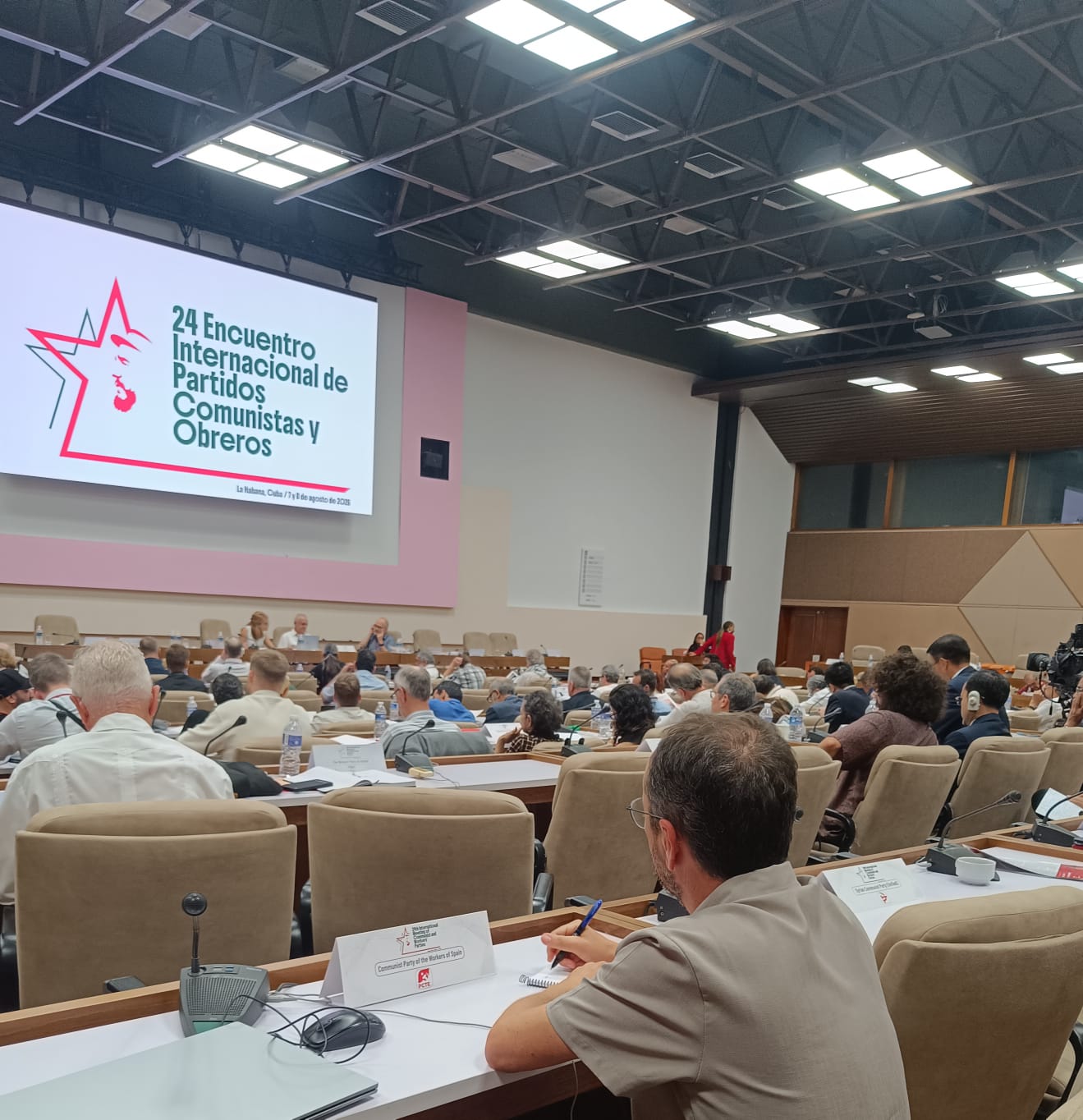
Havana, August 2026
Defending and honouring the legacy of the Cuban Revolution on the centenary of Fidel’s birth; deepening solidarity with socialist Cuba; strengthening our joint actions; and uniting our forces for peace and against imperialist aggression
The Communist Party of the Workers of Spain thanks the organisers for convening this meeting and extends fraternal greetings to all the participating organisations and, most especially, to the Communist Party of Cuba, the Cuban people, and all the individuals and organisations that keep solidarity with the Cuban Revolution alive.
The commemoration of the centenary of Fidel Castro’s birth is an occasion of particular importance to recall his life and work, assess the historical significance of the Cuban Revolution, and renew our commitment to solidarity with Cuba.
Fidel is part of the contemporary history of Cuba, Latin America, and the international communist and revolutionary movement. His figure is synonymous with an entire life devoted to socialism-communism and to the defence of workers’ and popular interests.
The Cuban Revolution opened a new stage in the history of the island. It made it possible to advance in building a social model that placed the needs of the majority of the population at its centre and turned fundamental rights into pillars of collective life.
The achievements made in areas such as education, healthcare, science, culture, and social protection are an international benchmark. Cuba has shown that, even under extraordinarily difficult conditions, it is possible to devote a country’s resources and capabilities to improving the living conditions of its people.
The expansion of education, the eradication of illiteracy, full equality between women and men, the development of a universal healthcare system, scientific training, and the promotion of culture form part of a legacy that must be known, defended, and carried forward into the future.
These achievements have also had to be developed under the effects of a sustained policy of economic, commercial, and financial blockade imposed by the United States for more than six decades.
The blockade directly affects the daily lives of the Cuban population. It hinders access to medicines, food, energy, technology, financing, and other essential resources. Its extraterritorial nature extends its effects far beyond relations between Cuba and the United States. Every country in the world is subjected to pressure and sanctions for maintaining normal relations with the island.
For this reason, the PCTE reiterates its demand for the immediate and unconditional lifting of the blockade. It is an unjust policy, prolonged for decades and directed against the living conditions of the Cuban people.
Opposition to the blockade must occupy a central place in solidarity work. Expressing sympathy for Cuba is not enough. It is necessary to explain the concrete consequences of this policy, combat disinformation, and promote initiatives capable of broadening social support for the Cuban people.
The Communist and Workers’ Parties present at this meeting share a common responsibility. We must improve coordination, ensure continuity in our campaigns, exchange experiences, and develop joint actions that enable solidarity to reach broader sections of the working class and the people in our respective countries.
Solidarity must be active, organised, and constant. It must be expressed through the political denunciation of the blockade, but also through material, cultural, educational, scientific, and social cooperation. It must foster a rigorous understanding of Cuban reality and combat campaigns that seek to reduce the complexity of the country’s situation to self-serving explanations.
Spain and Cuba are united by deep historical, cultural, and human ties. These ties provide an important basis for strengthening relations between our two peoples and developing initiatives of cooperation and solidarity.
We consider it necessary for Spanish institutions to maintain a clear and firm position against the blockade and to contribute to the development of normal relations with Cuba in all fields. They must also act to prevent coercive measures imposed by the United States from conditioning Cuba’s relations with European countries.
Fidel’s legacy also possesses a fundamental internationalist dimension.
For decades, Cuba has carried out extensive cooperation with numerous countries, particularly in the fields of healthcare, education, and science. Thousands of Cuban professionals have worked in places affected by epidemics, natural disasters, armed conflicts, or severe social deprivation.
Cuban medical cooperation has made it possible to care for millions of people who lacked access to healthcare services. Literacy programmes, the training of foreign students, and participation in development projects have turned solidarity into a concrete practice.
Cuba has not merely offered what it had left over. It has shared its knowledge, resources, and the efforts of its professionals even at times of great internal difficulty. This example takes on particular importance in a world marked by growing inequality, economic competition, the proliferation of conflicts, and rising military expenditure.
Against a conception of international relations based on imposition and the pursuit of profit, Cuba has defended cooperation, mutual assistance, and shared responsibility in addressing humanity’s major problems.
The Cuban experience demonstrates that internationalism is not an abstraction. It is expressed through doctors, teachers, scientists, and workers who place their abilities at the service of other peoples.
Honouring Fidel’s legacy means preserving and strengthening this conception of solidarity; it also means defending peace and opposing imperialist aggression.
Peace cannot be understood merely as the temporary absence of war. It requires combating the conditions that generate violence, inequality, exploitation, and conflict among peoples. It requires rejecting policies of pressure, economic sanctions, military threats, and any form of intervention intended to impose the interests of the great powers.
In the current international context, characterised by intensifying rivalries among powers and the danger of new conflicts, it is essential to strengthen the common action of communist, workers’, and popular organisations.
We must join forces against militarism, the arms race, and the use of peoples as instruments in disputes among powers. At the same time, we must maintain a clear position against the idea that changes in the international balance of forces will, by themselves, lead to a more just world. Lasting peace cannot be built upon competition among major economic interests, but upon cooperation, equality, and the fulfilment of popular needs.
The centenary of Fidel’s birth must not become a purely ceremonial occasion. Fidel was a revolutionary leader who defended the capacity of peoples to transform society in a revolutionary direction, the importance of political organisation, and the need to remain steadfast even in the most adverse circumstances.
Honouring his legacy means studying his thought and practice but also applying his lessons to the problems of our time. It means trusting in the strength of the people, understanding that great social achievements are not concessions but the result of organisation and struggle, and defending socialism-communism as the necessary and urgent alternative to capitalism, which produces nothing but inequality, crisis, exploitation, and war.
The Cuban experience demonstrates that the principal social achievements of its people have been made possible by socialist construction, social ownership of the fundamental resources, and the orientation of the economy towards satisfying collective needs. Preserving and strengthening these foundations is the best guarantee for defending the rights already won and continuing to advance in the face of the difficulties of the present.
The Communist Party of the Workers of Spain reaffirms its commitment to the Cuban Revolution, to denouncing the blockade, and to developing ever closer relations between our peoples.
We also express our willingness to continue working with Communist and Workers’ Parties and solidarity forces throughout the world to promote common initiatives.
The centenary of Fidel’s birth must serve to renew our commitments: our commitment to the memory and legacy of the Cuban Revolution; to the struggle for the lifting of the blockade; to internationalist solidarity; and to peace and opposition to imperialist aggression. It must also renew our commitment to socialism as a historical project capable of placing the economy, labour, and knowledge at the service of human needs.
From Spain, we convey to the Cuban people our respect, recognition, and solidarity.
We will continue working to strengthen joint actions, broaden the solidarity movement, and defend Cuba’s achievements and socialist future.